The Kremlin’s Holy Empire: Russia, Syria, Christian Nationalism and the Western Far-Right
Elon Musk describes himself as a “cultural Christian”. Fellow billionaire techbro Peter Thiel claims that his (“small-o orthodox”) Christianity is at the center of his worldview, and believes Greta Thunberg is the Antichrist. Tommy Robinson, former leader of the EDL, best-known for his virulent racist bigotry and long criminal record, “completely converted to Christianity,” during his last prison stay, according to fellow far-right Christofascist Islamophobe David Wood, joining Nick Griffin, Nigel Farage, and other newfound Christians of very questionable piety.
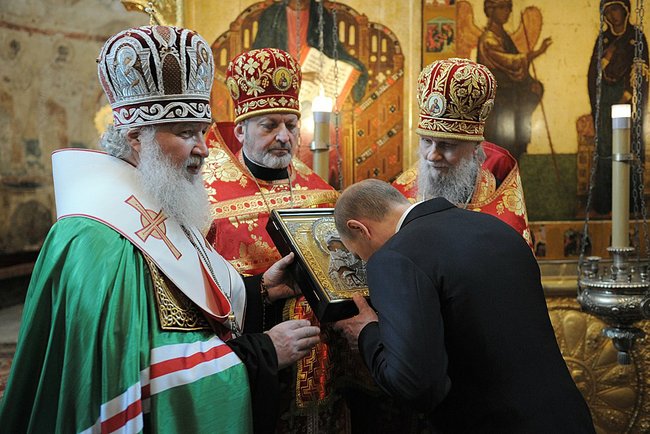
The Christian nationalism now being embraced across the Western far-right may seem like another US export — the demon child of tent revivalism and talking in tongues, as American as spray cheese, cowboy boots or apple pie. But this movement didn’t emanate solely from the United States; it grew through a two-decade ideological feedback loop between Vladimir Putin’s Kremlin, American evangelicals, and their European far-right peers. From the early 2000s onwards, US religious conservatives and white supremacists were already praising Putin as the defender of “Christian civilisation,” travelling to Moscow not for the onion domes and borscht but to seek inspiration from Russia’s new, ‘traditionalist’ anti-liberal identity.
The War on Terror gave Putin the perfect script: a civilisational struggle in which Russia — not the West — was the true Christian shield. In Syria, he perfected this myth. Today, its fallout is spreading across the Western world.
The post-9/11 era normalised the idea that the world was locked in a civilisational struggle between the Christian West and a monolithic, barbaric Islam as imagined by Samuel Huntingdon in which Al Qaeda was depicted as representative rather than an extremist aberration. Western governments and traditional media outlets, desperate to feed a social-media ecosystem hungry for rage-bait, mainstreamed a language of cultural siege that the far-right gleefully absorbed and reiterated. But no-one weaponised this more effectively than the Kremlin.
Putin recognised immediately that the West’s Islamophobia and a deep-rooted racism created a lucrative ideological market. Russia could present itself as the real bulwark against “Islamic terror” — stronger, purer, more traditional than the decadent, liberal West. When Washington talked about freedom, Putin talked about civilisation. When the US claimed to fight terror, Putin claimed to defend Christianity itself.
That reframing landed powerfully with Western extremists, already primed to believe it, and keen to popularize it.
The Early Pilgrims: Duke, Griffin, and the First Wave
Years before Trump, years before Crimea, and years before Aleppo was turned into a testing ground, Western white supremacists were making ideological pilgrimages to Moscow. David Duke lived there periodically, praising Putin as a defender of the white European race. Nick Griffin of the British National Party publicly admired Russian Orthodoxy and Russian “traditionalism.” Alexander Dugin — now best known as ‘Putin’s brain’ and ideological guru, but then an obscure far-right ideologue — became a kind of prophet for Western extremists long before mainstream analysts recognised his influence.
These were not accidental encounters.
For neo-Nazis, the appeal of Putin’s Russia was simple: a strongman, a Christian identity, a racialised civilisational story, anti-liberal politics, and a state willing to endorse it. In short, something approaching a white-nationalist empire — something America’s own Christian nationalists could not create domestically.
Syria: Where the Myth Was Perfected
Syria offered the Kremlin what the War on Terror and Chechnya alone could not: a global theatre in which to enact its story of holy war in real time.
When Russia intervened militarily in 2015, the propaganda choreography was immediate: missiles blessed by priests, soldiers framed as defenders of Christianity, and state media endlessly portraying Assad as a righteous protector against Islamist hordes. Assad’s actual faith was irrelevant. So was the fact that his regime tortured Christian dissidents just as readily as any other sect. Under Kremlin tutelage, Assad became a set piece in Putin’s new civilisational pageant.
The irony was grotesque: Assad’s security services had been trained for decades by Alois Brunner, one of Adolf Eichmann’s closest collaborators — a Nazi fugitive who shaped Syria’s torture system. Yet Western far-right groups and credulous Christian delegations travelled to Damascus, eager to see a “Christian protector” fighting barbarism.
This was no accidental misunderstanding. It was a carefully curated fantasy built on racism and age-old Crusader mythology. And it worked.
Syria made Putin’s claim believable to those already craving a strongman saviour. It gave Christian nationalists in the West the visual mythology they needed: images of a Christian emperor defending civilisation while the weak liberal West wrung its hands. The fact the image was completely false was no problem for a far-right whose worldview is founded on fabrications, falsehoods and myths of racial supremacy.
For Western audiences, “Third Rome” can sound quaintly medieval — a romantic Orthodox slogan. In reality, it’s the ideological backbone of the Kremlin’s modern identity. If the first Rome fell, and Byzantium became the second, then Moscow — so the doctrine goes — is the final and eternal centre of true Christianity. This is not merely religious sentiment. It is an imperial mandate. It tells Russia that it is the rightful leader of Christian civilisation, ordained to stand against the forces of secularism, modernity, and Islam.
This is precisely what America’s Christian nationalists — and Europe’s far-right — found intoxicating. Where US evangelicalism offered personal salvation and political grievance, Putin offered something bigger: a civilisational home.
This is where the historical rhyme becomes unavoidable.
While the Kremlin insists that “Third Rome” is a spiritual idea, its political use echoes the earlier “Third Reich” too closely to be mere accident. The parallels aren’t literal — Putin is not Hitler, Russia is not Nazi Germany — but the ideological rhythm is unmistakable. Both claim to inherit a sacred civilisational destiny; both fuse mythic history with authoritarianism; both present themselves as the final bulwark protecting a threatened civilisation. As the saying goes — though not by Twain — history doesn’t repeat itself, but it often rhymes.
American evangelicals became some of Putin’s most enthusiastic foreign audiences, mirroring his rhetoric about defending Western civilisation, masculinity, and the Christian family. European far-right parties — Italy’s Fratelli d’Italia, France’s National Rally, Germany’s AfD, Hungary’s Fidesz — adopted the same vocabulary. Giorgia Meloni praised Russia, Iran and Hezbollah for “defending Christians” in Syria. The UK's far-right Britain First party reinvented itself as a crusader movement after cultivating ties with Moscow. Assad and Khamenei weren't the only non-Christian authoritarians to embrace Putin's Christian nationalism, boosting their own supremacist creeds and repressive policies by association; Israel's Netanyahu and India's Modi also proudly boasted of their close ties with Putin — more strongman alliance mistaken for mere geopolitics rather than the ideological partnerships they truly were.
Christian nationalism has never been an organic spiritual revival. It was and is a manufactured identity — tested in Syria, refined in propaganda studios, and exported globally through far-right networks.
By the mid-2020s, this imperial theology had hardened into political infrastructure. Moscow is now a magnet for the Western far-right and home to the US neo-Nazi group The Base (or ‘Al-Qaeda’ in Arabic), drawing everyone from Alex Jones and Tucker Carlson to Geert Wilders, Matteo Salvini, Tommy Robinson, representatives of Britain First and AfD. It might be faster to list the far-right figures who haven’t made their pilgrimages to the Kremlin. Last month, an “international far-right, pro-Putin axis” was formally launched in Russia — a kind of ideological Comintern for the illiberal fascist hardcore.
For two decades, Christian nationalism has been misdiagnosed as a local pathology. It isn’t. It is the ideological export of a Kremlin that used the War on Terror to cast itself as the world’s Christian shield, perfected that lie in Syria, and fed it back to a West eager for strongmen.
The danger was never local. It’s global. And Syrians remain, so far, the only people to have successfully overthrown a Kremlin-backed fascist dictatorship built on state terror. The world should be learning from them.
By Ruth Riegler